About the author- The author of this article Subhendu Bikash Tahal is a Gold medalist in BA(POL.SC) and currently pursuing Post-graduation in Political science at Utkal University, and has also qualified for Junior Research Fellowship(JRF) and eligibility for Assistant Professor in the National Eligibility Test(UGC-NET).
A criminal should be encountered; he should be killed instantly by the police. If the criminal didn’t care about the human rights of those, who faced his bullets and stabbed to death with his knife, then why should precious time be wasted in arranging a fair trial for someone who committed heinous offences in the past- brutally killing the security personals and laymen alike. He should be treated with all the brutality and harshness he subjected people into. “Agar apradh karenge toh thok diye jayenge.” Gangster Vikas Dubey’s encounter reinforces and reiterates the above statement more than ever.

However, there is a difference between “thoki raj”( Indian express, Pratap Bhanu) and the raj of rule(rule of law). While the former emboldens the police to kill a criminal, the latter restricts them. The Rule of law ensures transparency and safeguards individual liberty. The rule of police curtails liberty and elevates chaos under the garb of order to the uneven plane of administration. “Thoki raj” can either be a result of brimming emotions or a consequence of unholy nexus. But both emotions and unholy nexus are harmful for the rule of law owing to their crippling of the criminal justice system.

India adheres to the principle of rule of law. Here, rule reigns not individual. It follows separation of power- legislature formulate laws, executive enforce the law, and judiciary ensures fair play. India has a constitutional scheme, which to be followed for every act of omission and commission by the public officials. The extra judicial killings are blatant violation of the foundational principles underpinning the democratic order. But these are not new in India, neither these are aberrations; rather under the cloak of self-defense the police encounter criminals and the cases of encounters are increasing faster than before. In Priyanka Reddy case the public showered rose petals on the police displaying their support for an act which was legally corrupt.
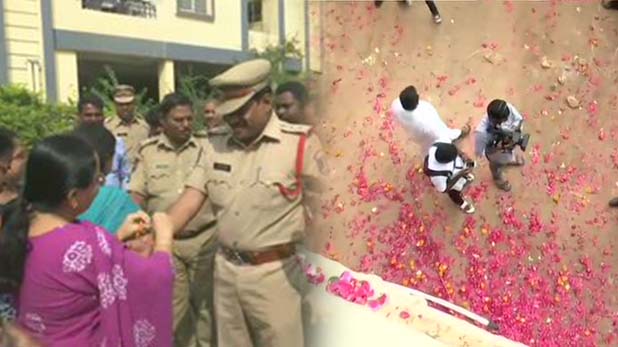
The chief function of judiciary in criminal justice delivery system is to give one what he or she deserves- retribution or unfettering of the shackles. The police only act as investigator; they maintain law and order and strengthen evidences against the person to be accused or acquitted by the court of law, if proved or disproved respectively. India has a vibrant Judicial system, although highly overloaded but functional and efficient. Its over-burdened feature spurs masculine police officers to kill the criminal imagining the truism that “justice delayed is justice denied”, and gaining post-facto public support for their stellar performances while forgetting on the other hand the principle of “innocent until proven guilty”. It is efficient because it retains its impartiality even if delayed thereby evoking profound respect from the public.
A criminal thrives under the patronage of police and politicians, the symbiotic relation breaks instantly when the criminal comes to the lime light. In the apprehension of they being exposed, they perpetrate plans to wipe the criminal out. Had Vikas Dubey been thoroughly investigated, he would certainly have exposed the labyrinth of criminal world. His death washed away with him, all the secrets of the criminal world and let the criminal world flourish untouched by the rule of law. Justice hurried is thus justice buried.

Extra judicial killings point fingers at our system of policing and the system of justice delivery. Sometime the excuses, that police are humans like us and they would attack when they are attacked overburdened by their work, lack of enough officials, and faulty training devoid of ethics, are cited. However it’s a systemic failure which undermines the entire judicial framework. Extra judicial killing is not something to be encouraged, it is no substitute to justice. Instead of encouraging the police officers, they should be held accountable for steeping out of their jurisdiction, speedy trial should be ensured, stringent action should be taken against the police officers involved. Thokiraj is harmful because it conceals more than it reveals.
 Subhendu's blog