Why Thokiraj is harmful.

About the author- The author of this article Subhendu Bikash Tahal is a Gold medalist in BA(POL.SC) and currently pursuing Post-graduation in Political science at Utkal University, and has also qualified for Junior Research Fellowship(JRF) and eligibility for Assistant Professor in the National Eligibility Test(UGC-NET). 

A criminal should be encountered; he should be killed instantly by the police. If the criminal didn’t care about the human rights of those, who faced his bullets and stabbed to death with his knife, then why should precious time be wasted in arranging a fair trial for someone who committed heinous offences in the past- brutally  killing the security personals and laymen alike. He should be treated with all the brutality and harshness he subjected people into. “Agar apradh karenge toh thok diye jayenge.”  Gangster Vikas Dubey’s encounter reinforces and reiterates the above  statement more than  ever.

However, there is a difference between “thoki raj”( Indian express, Pratap Bhanu) and the raj of rule(rule of law).  While the former emboldens the police to kill a criminal, the latter restricts them. The Rule of law ensures transparency and safeguards individual liberty.  The rule of police curtails liberty and elevates chaos under the garb of order to  the uneven plane of administration. “Thoki raj” can either be a result of brimming emotions or a consequence of unholy nexus. But both emotions and unholy nexus are harmful for the rule of law owing to their crippling of the criminal justice system.

India  adheres to the principle of rule of law. Here, rule reigns not individual. It follows separation of power- legislature formulate laws, executive enforce the law, and judiciary ensures fair play. India has a constitutional scheme, which to be followed for every act of omission and commission by the public officials.  The extra judicial killings are blatant violation of the foundational principles underpinning the democratic order. But these are not new in India, neither these are aberrations; rather under the cloak of self-defense the police encounter criminals and the cases of encounters are increasing faster than before. In Priyanka Reddy case the public showered rose petals on the police displaying their support for an act which was legally corrupt.
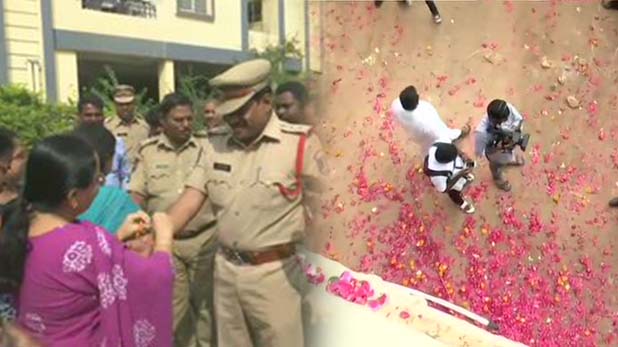
Representative image

The chief function of judiciary in criminal justice delivery system  is to give one what he or she deserves- retribution or unfettering of the shackles. The police only act as investigator; they maintain law and order and strengthen evidences against the person to be accused or acquitted by the court of law, if proved or disproved respectively. India has a vibrant Judicial system, although highly overloaded but functional and efficient. Its over-burdened feature  spurs masculine police officers to kill the criminal imagining the truism that “justice delayed is justice denied”, and  gaining post-facto public support   for their stellar performances while forgetting on the other hand the principle of “innocent until proven guilty”. It is efficient because it retains its impartiality even if delayed thereby evoking profound respect from the public.

  A criminal thrives under the patronage of police and politicians, the symbiotic relation breaks instantly when the criminal comes to the lime light. In the apprehension of they being exposed, they perpetrate plans to wipe the criminal out. Had Vikas Dubey been thoroughly investigated, he would certainly have exposed the labyrinth of criminal world.  His death washed away with him, all the secrets of the criminal world and let the criminal world flourish untouched by the rule of law. Justice hurried is thus justice buried.
Extra judicial killings point fingers at our system of policing and the system of justice delivery. Sometime the excuses, that police are humans like us and they would attack when they are attacked overburdened by their work, lack of enough officials, and faulty training devoid of ethics, are cited. However it’s a systemic failure which undermines the entire judicial framework.  Extra judicial killing is not something to be encouraged, it is no substitute to justice. Instead of encouraging the police officers, they should be held accountable for steeping out of their jurisdiction, speedy trial should be ensured, stringent action should be taken against the police officers involved. Thokiraj is harmful because it conceals more than it reveals.

The journey from the land of the stranger towards the land of his mother by Subhendu Bikash

About the author- The author of this article Subhendu Bikash Tahal is a Gold medalist in BA(POL.SC) and currently pursuing Post-graduation in Political science at Utkal University, and has also qualified for Junior Research Fellowship(JRF) and eligibility for Assistant Professor in the National Eligibility Test(UGC-NET).

The consummate veneer which had been used to wrap up the festering wound is no longer able to cover up the wound, time demands a serious response, without which no chemotherapy in future may work and the entire body will have to succumb to the wound. Four decades of socialism, and liberalization since 1990s, have not served the purpose of the men languishing at the lowest rung of economic pyramid. In search of jobs, fascinated by the opportunities and moreover, pushed by the poverty; a self respected individual who till then had been working on the field, changes his colour and through a middleman finally reaches the land of skyscrapers, hoping that now he could drench the stomach of his family by being able to provide square meal per day.

 On one fine day when the sky is clear, the environment is calm, when the earth has not been shaken, he hears the news from his fellow colleagues that a virus from the distant land has invaded India and he has to fight against the Virus as a soldier; then his unofficial conscription starts- no job , no social security, no savings; with his unrecognized efforts, his undervalued contribution, his underlooked labour, and no longer being able to tolerate the terrestrial radiation in empty stomach, without money in pocket, he starts his arduous journey again back towards his village, his own land; from the land of the stranger towards the land of his mother. The government meanwhile to save the millions of lives from the fatal covid-19 locks the entire country down; from cities to villages the  word ‘social distancing’ spreads like wildfire.

However, Trudging mountainous roads, difficult terrains the labourers, the men behind the flourishing cities  walk thousands of kilometers, without food and potable water, defying the call for social distancing; and their plight being covered by national media shakes the collective consciences of the nation. In a harrowing event exposing the hollowness and the deep reality of our socio-political structure fourteen men die of train mishap.

It appears like an old story; but the underlying message behind this story must be unwinded by the policy makers. The fragility of our economic system has been exposed. The men and women who build the cities, who work in factories, have been left to live their lives in destitution. Tired, dispossessed as they are, now in the village, don’t have the luxury of enjoying the social distancing, they need an immediate economic succor, and the government’s allocation for MGNREGA, although appears to be a panacea, however, hasn’t helped anyone as states have not evinced the much needed vigour.

The effervescence of achieving economic prosperity has died down,   in one fell swoop the pandemic and the subsequent lock-down have stolen all their dreams, shattered all their hopes;  bereft of money and on the brink of devastation, they are waiting for a helping-hand, hoping that the pandemic would soon go away and everything would come to normalcy. Some died while returning home, some returned home but with no penny in pocket are on the verge of economic paralysis.

When the Prime-minister decided to appear on the screen their ecstasy reached on the apogee, being overwhelmed by his magical words and announcement of a huge package of 10% of the GDP, finally they realized that someone at the top of the pyramid looks after them- the men on the bottom, maintaining the required equipoise and binding the entire societal pyramid with the thread of love, help and compassion. His clarion call to help the poor families became music to their ear, but soon this was to be belied with the five tranches announcement of the Finance Minister.  Her second tranche of announcement deals with Poor, including migrants and farmers; but no relief, only lip service.

Every cloud has a silver lining, every problem ushers a new hope, every crisis renders the opportunity to ponder and reflect on the past and start a new journey. Two questions which must be asked at this critical juncture, first, why people from villages throng towards the cities? And second, is it feasible to resolve this crisis?

Political scientist Professor Zoya Hassan writes “in India, the lockdown favours the “balcony classes”, with no regard of its consequence for others.” In India every policy helps the balcony classes, how this lockdown would have been an exception? Since independence the uneven economic development, the callousness of the policy makers towards the development of the hinterlands results in large scale migration. Lack of jobs, disguised unemployment, natural disaster, crop failure, no alternative economic opportunities, discrimination of various sorts push the people towards the cities, and the dazzling lights of the cities hold them there. However, in cities the distressed individuals work in hazardous condition, the safety net of labour laws are distant dreams for them; the social security schemes- they have never heard of, devoid of all the basic requirements they work there only because they don’t have any option. Once the economic engines cease to function, the daily wage earner’s hand turns numb, the obsession of tomorrow haunts him, the lack of food inflicts him physical and mental trauma. But in a situation like pandemic they face the double whammy of poverty and fear of being contracted with the virus; and once contacted,  the loss of immunity  may make the body the safest place for other viruses, thus weakening the individual physically, breaking him mentally, downgrading him socially and pauperizing him economically.  As she rightly puts it  “ Nobody is safe from the virus but some classes are more protected than others”,  some classes are more vulnerable  than others.

The question of feasibility of resolving the crisis doesn’t arise, because this is not a simple crisis, it’s a festering wound, if not operated immediately will bring the body into collapse. The pandemic has brought into the lime light the luxury of the few and pathetic tales of the many, the glaring inequalities. The policy makers have to bridge this gap not just by resurrecting the economy but extending the nurturing effects of the policy towards the hinterland and empowering the individuals at the lowest echelon of the economic strata. The crisis offers the opportunity to redress the long standing grudge of the society, which had been forgotten. It’s upon the policy  makers to tap into this opportunity and take India closer towards the goals set by the founding fathers of our Republic.